

MyPKD APP
Empowering PK Deficiency patients to take control of their health. A progressive web app for symptom tracking, lab management,
and patient support — shipped across 247 screens.


Overview
The MyPKD App is a Progressive Web Application designed for patients with PK Deficiency, a rare genetic blood disorder. This unbranded symptom tracking tool enables patients to monitor their symptoms, upload medical records, and generate comprehensive reports. The app facilitates more productive healthcare conversations by providing organized, data-driven insights that patients can share with their healthcare providers.
Team
Eloise, Lead Product Designer
Sta
Validation
User Testing
Duration
10 months
My role
Visual Design
Usability Design
Branding Design
Icon Design
Tools
Pencil and paper
Adobe XD
Adobe PS
What is PK Deficiency
PK Deficiency is a rare blood disorder that people are born with. It happens because of a missing enzyme called pyruvate kinase, which is important for keeping red blood cells healthy. Red blood cells carry oxygen throughout the body.
Without enough pyruvate kinase, red blood cells break down too quickly, leading to a condition called hemolytic anemia. This means the body can't keep a normal level of red blood cells, causing problems.
Symptoms of PK Deficiency:
1. Feeling very tired or weak
2. Shortness of breath
3. Pale skin
4. Yellow color in the skin and eyes (jaundice)
5. An enlarged spleen (the organ that removes old blood cells)
Some people with PK Deficiency may have mild symptoms, while others may have more severe problems. Over time, the condition can cause complications like gallstones, too much iron in the body, and in serious cases, liver or bone marrow problems.
Problems patients and HCP are having:
Lack of disease awareness and understanding:
As a rare disorder, PK Deficiency is not well-known or understood by many patients and healthcare providers.
Difficulty in tracking and communicating symptoms:
Patients with PK Deficiency often struggle to keep accurate records of their symptoms and communicate this information effectively to their healthcare team.
Limited access to support and resources:
Living with a rare disease can be isolating, and patients may have difficulty finding the support and resources they need to manage their condition effectively.
Challenges in treatment adherence and management:
Patients with chronic conditions like PK Deficiency often struggle to adhere to their treatment plans and manage their symptoms effectively.
Fragmented care and lack of coordination:
Patients with rare diseases often see multiple healthcare providers and may have difficulty navigating the complex healthcare system.
Outcome:
Design Approach:

DISCOVERY
Target Audience
-
20-30 years old, no children
-
Solo traveler to group of 6
-
Mid disposable income
-
Travel for leisure at least twice a year
Research Goals
-
Learn how target audience plan their trip itineraries
-
Know what tools people use to create trip itineraries.
-
Understand what sources most impact user’s plans.
Persona
I have interviewed with 6 people at the age from 22 to 30 and identified a personas with different consumption habits and barriers, examining their pain points, attitudes and levels of awareness concerning harmful use.

Key Findings
01/
02/
Sharing photos on social media is the trend
Leisure and relaxation are the main motivation
03/
Travelers like to collect locations even they don't have recent travel plans
04/
Travelers usually use 3 or more platforms for planning
Comparative Analysis
Base on the interview, I learn that many travelers collect trips locations from social media posts, and none of the current social media Apps have the function of making itinerary. According to my research most of the itinerary Apps are lack of self-upload function, users can only choose locations pre-set by the Apps.
.png)
DESIGN
Style Guide
The style guide is designed to craft a holistic and simple look. The duo primary colors create a modern feel and rounded corns create a friendly sense.


How might we provide travel destinations / photo spots to collect and create a painless process of making itinerary, which stop people from switching between Apps
OPPORTUNITY

No destination in mind?
Explore here
-
Browse through posts and get detailed information on specific locations
-
Use the nearby tab to discover hot locations close to you
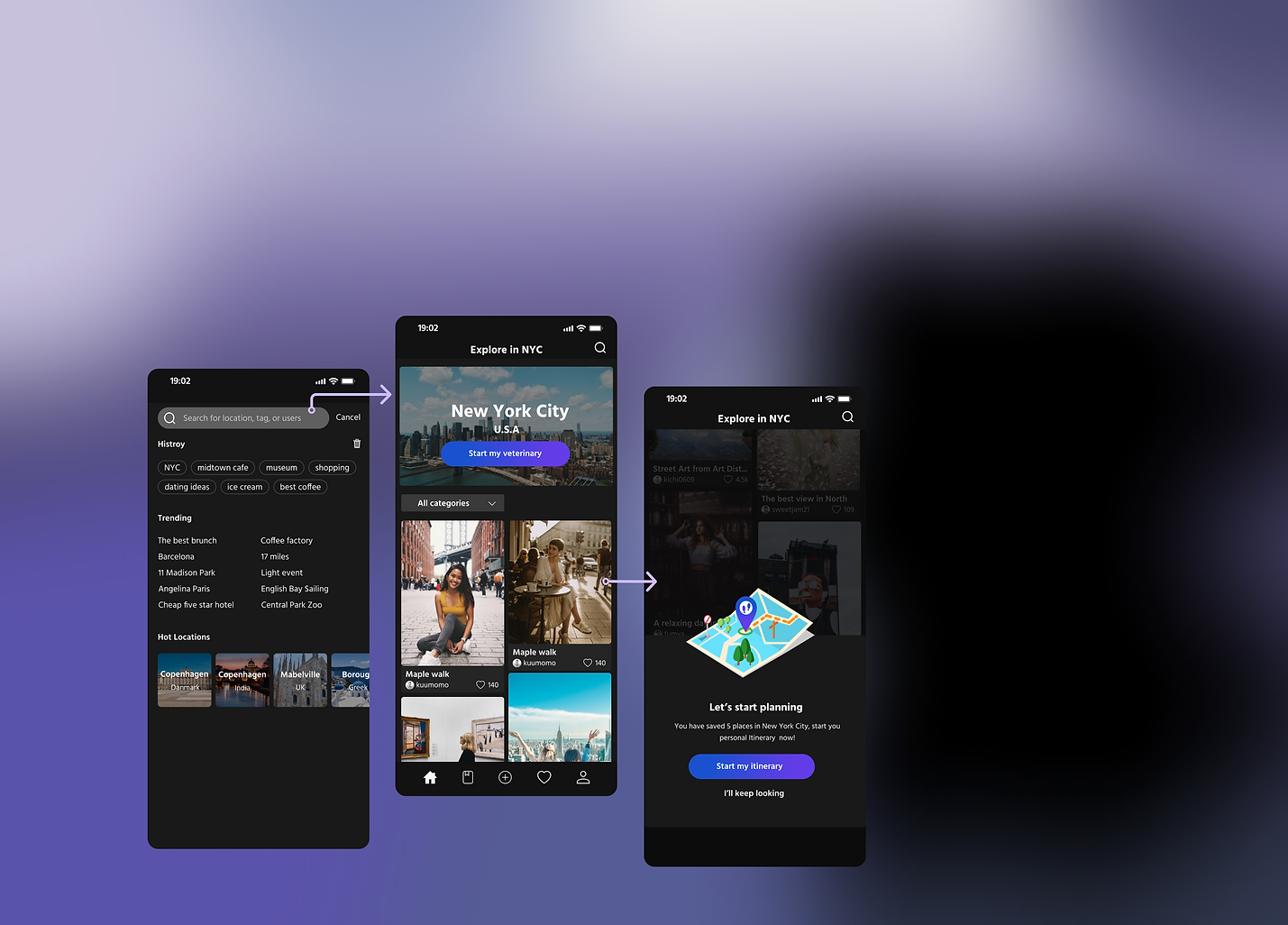
Have something in mind? Search here!
-
Search for any location you are interested in
-
Generate your personal itinerary with 5+ saved locations

Get your itinerary in 2 simple steps
-
First, select a country and a city
-
Second, select a date and use advance setting by option

Drag and move to customize your route
-
The route of current day will be displayed on the map
-
Drag and move the location orders will changes the route

Optimize your travel within one touch
-
Swipe left to delete, move, or replace your selected locations
-
Optimize your location orders to get the most rational route
Refections
I am not my user:
Before doing researches and interviews, I assume my target audience need a day-to-day detailed itinerary with safety alert. My assumption falls apart after having only two interviews, at that time I realized the pervious thoughts was to fulfill my needs not my users. So, I quickly change my direction and modify some of the interview questions, this helped me to find out the real pain point.
Don’t rush to make hi-fi:
As my first mobile App, I was really excited about designing it and wanted to see the work with final UI as soon as possible. Because of this overheated passion, I skipped some of the fundamental steps and jumped to design without fully consideration. This wrong move has caused me more time and effort to step back and redo 1/3 of the works. Fortunately, I was able to change this bad habit and learned the importance of following the design process. This experience also reminded me of what my art professor have said, “A beautiful painting without a subject is just a decoration, not art.”